Built above the drowned, choked and silenced cries of those whose children, grandchildren and great grandchildren lived and died as property under a false master's lash; built above the forgotten sweat and blood of those stolen men who lived and died on roadsides, in coal mines, in prison cells, voicing an anguish this country felt no responsibility to detect or assuage; built above the bodies of those who were firebombed, lynched, hosed, beaten, murdered and assassinated by a state and federal government that followed the whims of white democratic consensus and punished those who dared to assert their evident humanity; built above the shattered wishes, dreams and lives of those who thought that a society created by and for white people could function for them; built above the isolated, beaten and humiliated aftershocks of societally mandated poverty, who repeat the historical cycle of unrealized life and certain death by the millions, outside of the white imagination and by the writ of the same "justice" system that sees black murder as character building; built above the freshly added corpses of Oscar Grant, Sean Bell, Kimani Grey, Ousmane Zongo, Jordan Davis, Reginald Doucet Jr, Trayvon Martin and many, many, many others; built above the countenance of a yesterday that never left and tied to a tomorrow that's willfully revoked lies the edifice of deniability that stands as the foundation of modern racism.
For those whose skin anoints them as unhumanized and dehumanized; for those born with the beauty that white society would transform into a taint, the racial tiering of America is consecrated by the deafening howls of their suffering and murdered kin. For black people, history marks them; walks with them. Sculpting the terrain of their lives and fastening the grip of their restraints - regardless of their consciousness and consent. And though a measured, depersonalized distance is adopted to obscure what its victims die for unseeing, the same is true of their oppressor.
From birth they're covered with the spilled blood of those that were sacrificed to privilege their passage. Through infancy, they're placed on a mound of bones and corpses and conditioned to view them as both their cradle and their podium. Their parents - still guided by their ancestors - teach them to walk on stolen land, built by stolen hands. And embedded in their art and their news, housed in their minds and hearts and culminating in their words and their actions, the repeated truths of moral absence, of whiteness abound. Regurgitated through the channels of false authority that echo the parables of false supremacy. Singing anew the rationale of slave-owning founders and voicing the whispers of segregationist parents. Showing their progeny the same lie they, too, will learn to repeat to their progeny. Christening the belief - intimately held, and viciously defended - that closing their eyes erases the essence of whiteness that's daily purchased through the historical and omnipresent oppression willingly inflicted on black life.
But where blacks are haunted by the cries that history obscures and the tears that modernity stifles, whites are empowered by a lash that no longer requires a hand or a person or their knowledge to crack. Where blacks are relegated by the chains of white-enforced propriety to have their souls forced out of alignment with the smiles and restraint they're forced to show to white faces, whites are permitted to make their emotions and words - uncritically replete with their prejudices - the cusp of universal humanity. Where blacks labor under a system they did not create, burdened by a history that system refuses to correct, white politicians are left to use white culture and white morality justified with white arguments about white topics from white people to make a racially exclusive reality - scourged by the depth of what whiteness is incapable of considering - both culture and law. Where blacks walk with the implicit, collective threat of the noose transformed by "progress" into the bullet and the cage transformed by law into "justice", whites can look at police and see benefactors, look at democracy and see fairness, look at neighbors and see allies, look at neighborhoods and see peace, look at their country and see themselves, and look in their mirrors and outside of their windows and not see byproducts of collective effort, ordained by democratic will.
Always, that power - illegitimate in its origins, unchecked in its scope, and mundane in its exercise - veils as quickly as it acts. Clothed in loved faces and familiar voices; girded in "reason" and welded by the fires of slave insurrections into a language that's specific in its effects, but never in its targets; it acts and reacts through existence alone. Asserting behind denial its neutrality. Whispering behind closed doors and anonymous usernames its uncompromising fairness. Enacting - by law, by all - the "truths" that justify the boundaries of black life; just as it limits the imagined extent of black potential. That power - unmoved by identification, unmoored from accountability - radiates from the very whiteness it's reflected from; marking its territory in all words, all considerations, all exertion, all emotion, all love that stands unshared and unguided by its victims. For above all else, that power demands a vacuum. A closed circle wherein its expression normalizes its own corruption. A false reality wherein the very history that ensures its power is always irrelevant to the power of those who possess it. A bubble that presumes all spaces and all considerations should be and must be white, because the very nature of white existence suffers no truth that belies that.
It's within this context that blacks can be illiterate and uneducated because they dare to speak in a tongue that is not their presumptive masters'; because they've adopted a dialect borne from conditions they caused. It's within this context that racialization only happens when an aware person of color taints a white space with clear articulation of its whiteness. It's within this context that validity and fairness are regarded as a given when all life, all expression is filtered through white politicians, white intellectuals and white artists against the tyranny of presumptive white expectations. It's within this context that black women - who work within the interlocking evils of white patriarchy and white racism - can be simultaneously demeaned and oversexualized, overworked and deemed lazy, starving while dubbed leeches, voicelessly struggling while being called loud and overly angry. It's within this context that
all black men - who they'll never know and never deign to know - are
suspects of a never-proven violence that pales in comparison to the
intergenerational genocides that allow white civility. It's within this context that a black child can be shot and subsequently become responsible for his own murder.
This strange fruit - blossoming from a tree that was planted before this country's founding - is oft watered by the twin lies that keep white supremacy firmly rooted and ensure that its seeds travel from generation to generation, from thought to thought, from white person to white person, resting in the fertile complicity nursed by white denial and white action. Indeed, after four hundred years of history littered with the bodies of past and future children - with the bodies of past and future humans who were never fully deemed as such in life - we're still expected to believe them. They would ask us all to adopt their pose, close our eyes and think - as they do - that white existence - which facilitates the exercise of white power - is not racist, and that white expression and white thought without the removal of white privilege can be morally valid.
Weened on the hope that white racism can be confronted without white accountability, and internalizing the deception that white supremacy can be dismantled without convenience or sacrifice, whites have dominated racial discussion by culturally institutionalizing the notion that they lack any personal responsibility for its continuance. Because if, as white logic dictates, racism is always in the purview of political opponents and elders, of coworkers and strangers; if racism is always something someone else is doing at some other point in time, then what did I do to you? And the answer is written onto your skin, just as surely as the question is written onto mine: you were born.
Under a societal pretext where white skin carries humanity and brilliance and blackness carries dehumanization and serfdom, white existence in a white supremacist system isn't just a political statement, it's a political contribution. That truth was carved into the soul of this country with blood. That power was exercised - through constitution and law, through slavery and servitude, through lynchings and pogroms, through riots and firebombings, through segregation and redlining, through disparate arrest and disproportionate imprisonment, through exclusion and murder - on behalf of all whites, and to their universal benefit. That sickness is defended by deflection and inculcated by the illogic that distinguishes between reaping white supremacy's fruits and planting them. That contribution - historically uncorrected and presently unaltered - can never be neutral. And so we have America, where racism is inseparable from the very whiteness it's normalized.
And so we have America, where all white wealth is the direct
byproduct of white supremacy. Where all white political power is the direct byproduct
of white supremacy. Where all political thought that is not responsive to, accountable
to and consistent with explicitly anti-racist, non-white elements dedicated to
white supremacy's removal is white supremacist. Where all white institutions are white
supremacist. Where all white art is white
supremacist, and serves to falsely normalize the experience of white supremacy. Where all social interaction in white exclusive and white predominate spaces is white
supremacist. Where the system that guarantees your safety is white supremacist. Where the
military that combats what whiteness defines as a threat is white supremacist. Where much of the government directly elected by white majorities is white
supremacist. Where your history is white supremacist. Where your laws are white supremacist. Where your constitution is white supremacist. And, by consequence, so are you.
You don't face it by simply acknowledging it and feeling bad about it. You don't engage it under the presumption that "awareness" is sufficient for improvement. You don't atone for it by assuming that exercising the bare minimum of basic humanity absolves you of the greater responsibilities inherent to being genuinely moral and white under a white supremacist framework. You don't remove its taint by defining "good" under premises crafted by whiteness and by assuming that wielding power attained through historically evil means can remove your ends from that evil. You change nothing unless you realize that the only legitimate exercise of the power granted by white supremacy is its removal as a factor.
In the wake of a judicial system that can use lynching justifications to defend the murder of an unarmed teenager; in the wake of a jury of our peers operating without actual peers; in the wake of whiteness once again affirming that black life is an adequate sacrifice for its existence, many have called for justice - justice for Trayvon. Many have yelled, protested, organized and cried, guided by the symbolic understanding that overdue justice should come on behalf of all black people. But how is justice possible when its scales were weighted before its creation? And how are the scales balanced unless that weight is removed?
Time and again, history and reality has shown that the only power brooked by white supremacy is white power. Black people will protest, and white people will deem it sufficient to feel sorry for the black people protesting. Black people will demand equality, and white people will define equality as waiting for blacks to move to their level. Black people will fight, struggle and endure the violence ensured by a white system that democratically works to white ends, and white people will assume that writing sympathetic posts about it every once in a while will qualify as sufficient solidarity and activism. Always and again, black political engagement must work under the confines of a system that makes black exclusion integral to its existence. And white people - the only people - with the power to change that will look, notice, claim to see and do absolutely nothing about it.
White people will own the media and hire only white reporters, but claim that racism and privilege are too big to singularly fight. They will carry the largest blog audiences and primarily staff their rolls with white writers and wonder why their topics and audiences are homogenous. They will own the halls of academia and wonder why it's primarily attended by and staffed by themselves. They will own the businesses and hire within their white kin, their white friends and white allies and claim shock and sympathy when blacks report double the unemployment and half the wages with only a percentage of the wealth. They will be exclusively hired at businesses on all levels, but they'll refuse to make their presence contingent on the addition of non-white faces. They will exclusively be offered homes at prices undreamed of by their darker peers, but they won't offer their status on behalf of POC's to get homes. They will enter establishments and websites, homes and schools, businesses and social gatherings without ever speaking against, challenging or correcting - through diversity - the racism inherent to presumptive whiteness. They will attempt diversity, but reject its importance and reject its comfort if it means they're soundly outnumbered. They will attempt anti-racist activism and support political objectives that are racially beneficial, but only if there's evidence that it helps them too.
They will live in a country with forty million black people and make excuses for not knowing anything about them. They will live in black neighborhoods, voyeuristically scope out black spaces, and even make "black friends" and never meaningfully engage with them. They will support films and television with all and mostly white casts but deem anything with all black casts too racial to even try out. They will support the lie that high literature is white; excluding black thinkers, black writers and black radicals from their libraries while wondering why some black people don't seem to enjoy reading. They will define "proper grammar" by how they speak and wonder why some demographics - who lack the benefit of speaking the same English at home and at school - might have issues. They will hear those differences, and place the responsibility for learning on the children instead of themselves and the material. They will hear the arguments, complaints and critiques of innumerable people of color, wrapped in restrained, diplomatic language or tucked neatly behind ignored comments sections and think that they're showing their racial awareness by simply rejecting the idea that they're not being problematically racial because they don't feel problematically racial. They will serve on all white juries and feel no responsibility to provide the empathy, the history, the context or the mercy their laws are incapable of allowing. They will clearly see black problems, but will refuse to see how directly it relates to their problems. They will, in their internally accepted words and thoughts, in their internally normalized feelings and actions, in their internally justified politics and morality exercise power - white power - to exclusively white ends and they will ignore that its exercise necessitates and embodies racism; ignore that it's all rooted in the benefits acquired by our racist history. And they will do nothing.
They will do nothing.
It's that fundamental inaction - justified by the racialized possession of power, and the internalized assumption that negative racialization doesn't inherently apply to all white power - that calcifies racism. Historically and presently, blacks are expected to work and labor, fight and struggle, protest and argue to reach impossible heights for the sake of parity. But whites are never expected to acknowledge unchanging, illegitimate disparities; they're never asked to acknowledge how wholly their humanity has been compromised by systemic participation and collectively step down. Whites are societally permitted to reap the fruits of racism, but never made to internalize that racism's eradication is contingent on them giving up those fruits. They're never asked to look at the disparity between white and black authority and make sure that they only apply white power to enhance black power. We're to believe, against all evidence, that racism and the cultural codification of racialized whiteness is something that just happens. We're to believe, against all proof, that white supremacy is not the consequence of self-interested parties coldly making the calculation that black suffering - properly managed, and moved far enough out of sight - is an adequate price for "normal" American life. And with every action that neither removes their own power or enhances black power, they make their choice.
Even now, in the face of a corpse that did not have to be, even now, against the cries of a people echoing the unfulfilled wishes of their forefathers, even now, when the black vote is no longer a guarantee, even now, when the need for white action is readily apparent, even now, when the availability of evidence for racism has never been wider or broader, even now, they make their choice.
And they don't expect us to notice.
Saturday, July 20, 2013



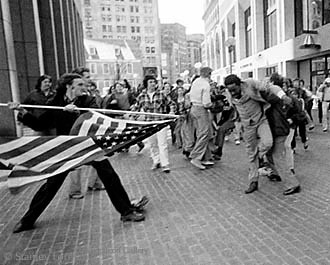
Wednesday, July 17, 2013
The Struggle Continues
Mychal Denzel Smith:
But he's right.
So what’s next? My fellow Nation contributor Salamishah Tillet told me a story about the legendary jazz singer Nina Simone. After the church bombing that killed the four little girls in Birmingham, Alabama, Simone went to her shed and tried to make herself a gun. Her husband walked in on her and asked what she was doing. She replied she was making a gun because she wanted to kill someone. He replied, “But you’re a musician.” Then she wrote “Mississippi Goddamn.”He's right. I've been fighting this since Saturday evening, and I don't know how long I can keep it up.
What’s next is that each of us take whatever gift we have and use it in a way that honors and values black life. That is the legacy Trayvon Martin can leave to this world.
But he's right.
Saturday, January 7, 2012
The Callous Mendacity of Ron Paul Supporters
War fatigue, disenchantment, disappointment, consistency. These words no longer have a place as characteristics or reasons. Their application - as with so much rhetoric in American politics - has morphed from a rationale to hold political opinions to an excuse to reject political perspective. Ron Paul is many things, but amongst them, he's a force of revelation. Exposing - for all to see - the face that America conceals under a mask which mythologizes a false shared equality and a false shared opportunity. He has shown, again, the blood that lies beneath the thin layer of American soil that we forget to claim as our true ground. He has extracted the ghosts of Barry Goldwater, Storm Thurmond, George Wallace and the whole of the Confederacy. And his followers - comprised almost entirely of the permanently empowered white male majority - dare to insist that history - both America's and Ron Paul's - be set aside to "grapple" with the advancement of their pet issues.
Writers more patient and forgiving than I have engaged this farce on their terms. I reject that impulse. There are priorities that render isolated disagreements with a president's policies small. There are sins that are nearer, older, crueler and more encompassing than the Military Industrial Complex's institutional impulses. And there are considerations that expose the negligent superficiality innate in trying to paint acidic poison as an oasis that will cleanse this country's soul of dried blood. The forces that would dismiss this; the forces that would belittle its significance; the ones that would point to the fire in the distance while ignoring the rot on their person forget that much of that blood is not foreign. They forget that much of that blood was grafted onto this country not for love of evil, but through a systemic effort to reason - through laws, religion, culture and principle - that evil is a naturally mandated good. They forget that America's original sin had a rationale.
Before there was liberty, there was the states' right to deny it to you. Before there was freedom, there was the states' right to limit its scope. Before there was a United States, there was the states' right to own some of its citizens. Before the equality of all was acknowledged, there was the states' right to violently enforce a century-long apartheid to ensure that equality for some would never have to be recognized. Before property rights described the ownership of things, it described the ownership of people. To be deaf to the chorus of old, to be ignorant of the clarion calls that united secessionists, segregationists and slave owners is to relive the privileged, unreflected luxuries that perpetuate a malediction that America refuses to account for.
There are some who would have you look at positions that flow from these premises as things to be judged in isolation; divorced from the associations and impact granted by history. They would have you forget that it was words ("3/5ths", "nigger", "states' rights", "property rights", "individual liberty", "government intrusion") that clarified the premises which translated to actions (slavery, racism, secession, slave-ownership, segregation, Civil Rights opposition). They would have us drink in America's ritualized amnesia and deny not just Jim Crow itself, but the culturally compelled fragility that lingers as a consequence of pretending that Jim Crow could never happen again. An embrace of Ron Paul - even a passing one - is not an embrace of the positions where he "sounds" reasonable, but an embrace of a man who reaches those "reasonable" positions by associating with, drawing from and advancing ideas that are rooted in the darker recesses of American consciousness.
I submit that those who claim that Democrats/liberals should feel conflicted about Ron Paul; who pontificate from a perch of unreflected self-righteousness that he embodies virtues that all "principled" non-partisan liberals should engage with are guilty of the highest distortion wrought from the most unearned of privilege. These people - often white, often male - speak of principle, of liberty, of morality, but they speak of them as though every moral person must work within their calculus. They speak as though privileged thoughts represent the cusp of considered balance. And in so doing, they write screeds dressed as edicts; blithely demanding sacrifices - both political and material - from women and minorities while writing off that sacrifice's inherent disproportion. Ensconced in false authority, they ask of those not-them more than they ask of themselves, and then call their judgment justified and considered. I reject their frame, as I reject all frames drenched in the soft evils that grant this discussion life. Indeed, I reserve my right to take their arguments and their words for what they are: the cessation of moral authority.
To be American is to contend with more than just the considerations of the moment. To be American is to contend with - and consciously push against - a centuries long historical arc that's considered the destitution of one group a just toll for the elevation of another. So when I speak of Ron Paul; when I outline the various reasons why and how he's anathema; when I point out how his public existence is inimical to America just as surely as his philosophy is inimical to liberalism, I feel, justifiably, viscerally and morally - though I now know this is not true - that I should have to go no further than this:
To honestly engage Ron Paul, you can't argue and ask others to argue his ideas within the limited confines of his articulation, but rather through the consequences of his ideas when they were tried. We lived in a world where the federal government refrained from intervening when a white majority had used the powers constitutionally granted to the state to resign their fellow black citizens to an inferior, poorer, America where their status as political nothings left them permanently endangered. This is what the states, untethered from the federal government, reserved as its right to do:

The privilege entertained by reducing Ron Paul's ongoing opposition to the Civil Rights Act to an off-hand footnote is the privilege frequently indulged when white people feel validated in drawing a high-minded distinction between explicitly racist words and explicitly racist results. To argue for Ron Paul's political consideration is to cast yourself as an enemy of the engines of progress. To separate the man from the implications and applications of his concepts, is to look askance at the oppression of your brothers and sisters and say that not only doesn't it matter, but that you don't care. Ron Paul supporters don't merely lie, they cowardly scatter when challenged to engage in the entirety of what giving him a national podium means for people-not-them. His rise doesn't just offend: it hearkens back to a time when it took the generational sacrifices of a whole race to understand that locally centered oppression caused by groups of "individuals" is not inherently more "free" than government power exercised as a means to protect locally unrecognized freedoms. I recognize no power, no authority that can call itself moral or valid and subtly demand that Americans consider someone who'd return us to that evil.
It takes more than saying you want liberty to grant liberty. It takes more than saying you're for a less powerful government to ensure a less powerful government. In a world consistent with Ron Paul's ideals, we get neither. He is not - nor has he ever been - against authoritarianism. He is not - nor has ever been - for freedom. Ron Paul's overriding principle is inextricably woven into the very forces that would localize fascism and cast the legal allowances that construct modern civilization into oblivion: blanket opposition of all federal action. In his conception of government, local power - as decided by the states - remains untouched by federal intervention. When Ron Paul says "liberty" he never intends for liberty to include, encompass, ensure or incorporate civil rights. Innate to his argument is the allowance of any excess, any oppression, any malfeasance as long as it's dictated by the states. The areas where liberalism and Ron Paul's brand of isolationist tentherism coincide are fundamentally illusory in nature for this reason.
That this truth has eluded many liberals in recent weeks has been troubling. In their meekly qualified support/defenses for Ron Paul, they surrender the moral ground that's foundational liberalism. They surrender the understanding that all power, not just federal power can be used for ill. They betray the lived history of poverty that solidifies our commitment to public assistance of poor. They betray the lived history of corporate despotism that clarifies our support for unions. They betray the lived history of women as unequal chattel that energizes our need to keep their autonomy and their place as equals in America. They betray the lived history of predatory blackmail and thievery that justifies our desire for healthcare. They betray the lived history of corporate greed and indifference that outlines the necessity of food, drug, environmental and economic regulation. They betray the history of collective effort that undergirds the very sense economic justice that validates taxation of the wealthy. They betray the understanding of racism as a generational ill that requires generational correction. And they squander - with no promise of recompense - the human considerations that stand as pillars for liberalism's place in the political spectrum.
Supporting Ron Paul or "raising awareness" for the parts of his candidacy that you like isn't an abandonment of liberalism because he disagrees with you. It's an abandonment of liberalism because Ron Paul's philosophy itself is antagonistically hostile to almost every premise, every consideration and every issue that liberals claim to support. Think about what you believe. Think about why you believe it. Think about the facts that inform that belief. Remember the actual people - not the principle - but the people that inspire you to maintain it. Then see how Ron Paul fails to share either your regard or your rationale.
Liberals who oppose the drug war see it as a totalitarian, oppressive, racist-enforced perversion of paternalism and would end it on all levels. Ron Paul opposes it because he believes the federal government shouldn't have the authority to regulate anything. A person who's against drug prohibition wouldn't merely oppose it on the federal level. A person who thinks that the individual rights of people - regardless of their location - are inalienable and should never be broken would make that their rationale. He doesn't. Instead he simply passes the question to the states while ignoring that federal prisons only have 200,000 of our prison population. The states have around 2,000,000. Ron Paul's vision, exercised on his own terms has no corrective for this:
How is that liberal?
Liberals who oppose the Patriot Act see the steady erosion of our constitutional rights, starting with the Bush administration and continuing with the Obama administration as unconscionable. There's an understanding that not just the potential, but the actuality of abuse is a threat to our privacy and thus, to our civil rights. Ron Paul opposes the Patriot Act because it ruins the concept of private property just like the Civil Rights Bill:
Liberals are rightfully suspicious - if not entirely against - many forms of armed conflict. They see a defense budget that's larger than the defense budget of our next 10 competitors increased during a period where our government is calling America "broke". They see our hammer's habit of conjuring nails and then calling them swords. They see the continuance of wars that have long since been detached from any meaningful purpose, and were furthered without public justification and without their consent. They see the violence of militarism on foreign citizens that have done nothing to us in countries that have done nothing to us and they deem that unacceptable. But in our distaste for blood and in liberal displeasure with a President who never promised to wash our hands of it, liberals not only made an anti-war candidate out of someone who isn't anti-war. We've ceded as a model, someone who would withdraw from all alliances, and back out of the UN as well as the ICC while ending foreign aid. Ron Paul's stance isn't pacifistic and it's only coincidentally non-interventionist. His foreign policy is little more that a national adoption of the paleoconservative refrain "None of my business":
Ron Paul's rise is a travesty that cannot be excused. To be complicit in it is to be complicit in the rejection of modernity. I'm not wholly unsympathetic to the various disappointments that have fanned liberal outrage, but none of those disappointments can be counted as valid reasons to mistake a national omen for a national savior. If liberals have issues that need to be advanced, look to Wisconsin, look to Ohio, look to the Keystone Pipeline protestors as inspiration. See what the organized exercise of democracy and citizen engagement can do, see the virtue in sustaining it and the necessity of participating in it. Look to those who don't think government power is irreversibly bad, but to those who know that government can be significantly better. Accept that the advancement of Paul is inseparable from the defeat of liberalism as a civil rights, women rights, institutional equality, social services and economic justice philosophy. Accept that such an embrace from the context of liberalism isn't just deeply unacceptable, but inherently so. Accept that even as a non-liberal, Ron Paul represents a boundary that no American should ever cross. Ever. And that every vote, every argument, every duplicitous comparison between Ron Paul and Barack Obama is a step toward crossing it.
Not all of us have the benefit of living in a world where we can trust that the states would permit the rights that the federal government guarantees. Not all of us can question - in the abstract - what liberties we would see if sexual harassment and abortion were "left to the states". Not all of us are positioned to apathetically hypothesize about the effects of removing the Civil Rights and Voting Rights Act (which Paul also voted against) in a world where millions of minorities face an imminent threat of voter disenfranchisement. This isn't just brainstorming for a significant majority of the country. The threat is real. And Ron Paul has made no secret of his desire to create a world where only the already-empowered have power. It should be a point of mourning for Americans that the rights of its weakest citizens are so disregarded that this has to be frequently and forcefully pointed out.
Many bloggers from Digby, to BooMan, to Zandar, to Maha, to David Neiwert and to Scott Lemieux have been penetrating and insightful on this topic. And often without falling into the putrid requests for principled consideration demanded by Glenn Greenwald, Andrew Sullivan, Conor Friedorsdorf, E.D Kain and others. I suggest that you read the first set to learn and confirm what you should know and that you read the second to know what - and who - you should dismiss.
Edit: I left out the singularly disqualifying fact that Ron Paul made millions from nakedly racist newsletters. I also omitted the fact that Ron Paul boasted about his authorship of them until it became convenient to deny them. I even avoided mentioning how the racists and the neoconfederates he associates with seem to be more attuned to things that lead to racism than people who claim to have an objection to it. While the newsletters confirm even the worst implications you can make about Ron Paul's conclusions about race, I find that establishment writers have done a good job making 2000 word posts telling us how good Ron Paul is and then "proving" they're not sympathetic or indifferent to racism by inserting a single sentence or paragraph about how the newsletters are really, really bad. I felt it important to emphasize that Ron Paul's noxious place in the public discourse is as much for his philosophy as it is for his words. I felt that focusing solely on those lets way too many people evade what it means to elevate someone like Ron Paul.
Oh, and I know I'm engaging in Soviet-Chinese style internment of political dissidents by calling Ron Paul a shameless crank in addition to a racist sociopath, but Ron Paul is both of those things. He thinks that we should return to the gold standard despite its economic volatility. Ron Paul's dear friend Llewellyn Rockwell was kind enough to publish one of his speeches, where Ron Paul warned that the UN was prepared to overrule constitutional law and establish a world government. Ron Paul has repeatedly claimed that in his first year of office, he will cut 1 trillion dollars from our budget - thus ensuring a minor...you know, economic collapse. And on his very website he not only effectively calls for a 0% across the board tax rate, but he promises to never, ever raise the debt ceiling, thus codifying the reality of a worldwide economic disaster. All to make sure Big Government doesn't exist. I wish Greenwald would be so kind as to supply his definition of crazy so I can see how Ron Paul misses his deserved inclusion.
Writers more patient and forgiving than I have engaged this farce on their terms. I reject that impulse. There are priorities that render isolated disagreements with a president's policies small. There are sins that are nearer, older, crueler and more encompassing than the Military Industrial Complex's institutional impulses. And there are considerations that expose the negligent superficiality innate in trying to paint acidic poison as an oasis that will cleanse this country's soul of dried blood. The forces that would dismiss this; the forces that would belittle its significance; the ones that would point to the fire in the distance while ignoring the rot on their person forget that much of that blood is not foreign. They forget that much of that blood was grafted onto this country not for love of evil, but through a systemic effort to reason - through laws, religion, culture and principle - that evil is a naturally mandated good. They forget that America's original sin had a rationale.
Before there was liberty, there was the states' right to deny it to you. Before there was freedom, there was the states' right to limit its scope. Before there was a United States, there was the states' right to own some of its citizens. Before the equality of all was acknowledged, there was the states' right to violently enforce a century-long apartheid to ensure that equality for some would never have to be recognized. Before property rights described the ownership of things, it described the ownership of people. To be deaf to the chorus of old, to be ignorant of the clarion calls that united secessionists, segregationists and slave owners is to relive the privileged, unreflected luxuries that perpetuate a malediction that America refuses to account for.
There are some who would have you look at positions that flow from these premises as things to be judged in isolation; divorced from the associations and impact granted by history. They would have you forget that it was words ("3/5ths", "nigger", "states' rights", "property rights", "individual liberty", "government intrusion") that clarified the premises which translated to actions (slavery, racism, secession, slave-ownership, segregation, Civil Rights opposition). They would have us drink in America's ritualized amnesia and deny not just Jim Crow itself, but the culturally compelled fragility that lingers as a consequence of pretending that Jim Crow could never happen again. An embrace of Ron Paul - even a passing one - is not an embrace of the positions where he "sounds" reasonable, but an embrace of a man who reaches those "reasonable" positions by associating with, drawing from and advancing ideas that are rooted in the darker recesses of American consciousness.
I submit that those who claim that Democrats/liberals should feel conflicted about Ron Paul; who pontificate from a perch of unreflected self-righteousness that he embodies virtues that all "principled" non-partisan liberals should engage with are guilty of the highest distortion wrought from the most unearned of privilege. These people - often white, often male - speak of principle, of liberty, of morality, but they speak of them as though every moral person must work within their calculus. They speak as though privileged thoughts represent the cusp of considered balance. And in so doing, they write screeds dressed as edicts; blithely demanding sacrifices - both political and material - from women and minorities while writing off that sacrifice's inherent disproportion. Ensconced in false authority, they ask of those not-them more than they ask of themselves, and then call their judgment justified and considered. I reject their frame, as I reject all frames drenched in the soft evils that grant this discussion life. Indeed, I reserve my right to take their arguments and their words for what they are: the cessation of moral authority.
To be American is to contend with more than just the considerations of the moment. To be American is to contend with - and consciously push against - a centuries long historical arc that's considered the destitution of one group a just toll for the elevation of another. So when I speak of Ron Paul; when I outline the various reasons why and how he's anathema; when I point out how his public existence is inimical to America just as surely as his philosophy is inimical to liberalism, I feel, justifiably, viscerally and morally - though I now know this is not true - that I should have to go no further than this:
However, contrary to the claims of the supporters of the Civil Rights Act of 1964 and the sponsors of H.Res. 676, the Civil Rights Act of 1964 did not improve race relations or enhance freedom. Instead, the forced integration dictated by the Civil Rights Act of 1964 increased racial tensions while diminishing individual liberty.I deem softcore and hardcore Ron Paul boosters mendacious; I acknowledge them as liars, not merely for their capacity to lie to others about what Ron Paul believes, but for their limitless ability to summon a combination of ignorance and privilege to lie to themselves. The most potent truth endemic to Ron Paul's political philosophy is that everything he proposes - everything - has not only been tried, but has been rightfully rejected by Americans once truth made the appeal of his ideals in the abstract an unqualified failure in function. His "solutions" don't speak to a vision of America that wasn't tried, but rather to a reality of America that didn't work. His attachment to ideas long after their horror has been made manifest doesn't make him brave or a visionary. It makes him wrong. Not in the way of someone misunderstands facts, but in the way of someone who internalizes conclusions that augured the oppression of whole demographics long after that result is proven.
The Civil Rights Act of 1964 gave the federal government unprecedented power over the hiring, employee relations and customer service practices of every business in the country. The result was the massive violation of private property and contract, which are the bedrocks of free society.
...
The Civil Rights Act of 1964 not only violated the Constitution and reduced individual liberty; it also failed to achieve its stated goals of promoting racial harmony and a color blind society. Federal bureaucrats and judges cannot read minds to see if actions are motivated by racism. Therefore, the only way the federal government could ensure an employer was not violating the Civil Rights Act of 1964 was to ensure that the racial composition of a business's workforce matched the racial composition of a bureaucrat or judge's defined body of potential employees. Thus, bureaucrats begin forcing employers to hire by racial quota. Racial quotas have not contributed to racial harmony or advanced the goal of a color blind society. Instead, these quotas encourage racial balkanization, and fostered racial strife.
...
Relations between the races have improved despite, not because of, the 1964 Civil Rights Act.
To honestly engage Ron Paul, you can't argue and ask others to argue his ideas within the limited confines of his articulation, but rather through the consequences of his ideas when they were tried. We lived in a world where the federal government refrained from intervening when a white majority had used the powers constitutionally granted to the state to resign their fellow black citizens to an inferior, poorer, America where their status as political nothings left them permanently endangered. This is what the states, untethered from the federal government, reserved as its right to do:
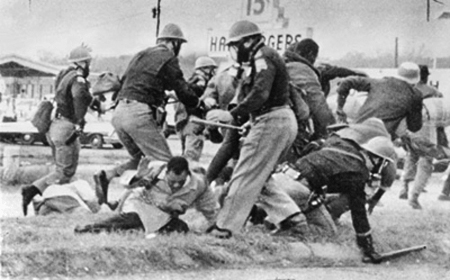
We lived in a world where the hypothetical liberties of inanimate property transcended the lived liberties of actual people. This is what the defense of those liberties looked like:Violence in Alabama was organized by Birmingham Police Sergeant Tom Cook (an avid Ku Klux Klan supporter) and police commissioner Bull Connor. The pair made plans to bring the Ride to an end in Alabama. They assured Gary Thomas Rowe, an FBI informer and member of Eastview Klavern (the most violent Klan group in Alabama), that the mob would have fifteen minutes to attack the Freedom Riders without any arrests being made. The final plan laid out an initial assault in Anniston with a final assault taking place in Birmingham.
On May 14, Mother's Day, in Anniston, Alabama a mob of Ku Klux Klansmen, some still in church attire, attacked the first of the two buses (the Greyhound). They tried to leave, but a person in a car kept blocking the bus as it tried to leave. The KKK members then slashed its tires. They forced the crippled bus to stop several miles outside of town, and it was firebombed shortly afterwards by the mob chasing it in cars. As the bus burned, the mob held the doors shut, intent on burning the riders to death. Sources disagree, but either an exploding fuel tank or an undercover state investigator brandishing a revolver caused the mob to retreat, allowing the riders to escape the bus. The riders were viciously beaten as they fled the burning bus, and only warning shots fired into the air by highway patrolmen prevented the riders from being lynched.That night, the hospitalized Freedom Riders, most of whom had been refused care, were removed from the hospital at 2 AM, because the staff feared the mob outside the hospital.

The privilege entertained by reducing Ron Paul's ongoing opposition to the Civil Rights Act to an off-hand footnote is the privilege frequently indulged when white people feel validated in drawing a high-minded distinction between explicitly racist words and explicitly racist results. To argue for Ron Paul's political consideration is to cast yourself as an enemy of the engines of progress. To separate the man from the implications and applications of his concepts, is to look askance at the oppression of your brothers and sisters and say that not only doesn't it matter, but that you don't care. Ron Paul supporters don't merely lie, they cowardly scatter when challenged to engage in the entirety of what giving him a national podium means for people-not-them. His rise doesn't just offend: it hearkens back to a time when it took the generational sacrifices of a whole race to understand that locally centered oppression caused by groups of "individuals" is not inherently more "free" than government power exercised as a means to protect locally unrecognized freedoms. I recognize no power, no authority that can call itself moral or valid and subtly demand that Americans consider someone who'd return us to that evil.
It takes more than saying you want liberty to grant liberty. It takes more than saying you're for a less powerful government to ensure a less powerful government. In a world consistent with Ron Paul's ideals, we get neither. He is not - nor has he ever been - against authoritarianism. He is not - nor has ever been - for freedom. Ron Paul's overriding principle is inextricably woven into the very forces that would localize fascism and cast the legal allowances that construct modern civilization into oblivion: blanket opposition of all federal action. In his conception of government, local power - as decided by the states - remains untouched by federal intervention. When Ron Paul says "liberty" he never intends for liberty to include, encompass, ensure or incorporate civil rights. Innate to his argument is the allowance of any excess, any oppression, any malfeasance as long as it's dictated by the states. The areas where liberalism and Ron Paul's brand of isolationist tentherism coincide are fundamentally illusory in nature for this reason.
That this truth has eluded many liberals in recent weeks has been troubling. In their meekly qualified support/defenses for Ron Paul, they surrender the moral ground that's foundational liberalism. They surrender the understanding that all power, not just federal power can be used for ill. They betray the lived history of poverty that solidifies our commitment to public assistance of poor. They betray the lived history of corporate despotism that clarifies our support for unions. They betray the lived history of women as unequal chattel that energizes our need to keep their autonomy and their place as equals in America. They betray the lived history of predatory blackmail and thievery that justifies our desire for healthcare. They betray the lived history of corporate greed and indifference that outlines the necessity of food, drug, environmental and economic regulation. They betray the history of collective effort that undergirds the very sense economic justice that validates taxation of the wealthy. They betray the understanding of racism as a generational ill that requires generational correction. And they squander - with no promise of recompense - the human considerations that stand as pillars for liberalism's place in the political spectrum.
Supporting Ron Paul or "raising awareness" for the parts of his candidacy that you like isn't an abandonment of liberalism because he disagrees with you. It's an abandonment of liberalism because Ron Paul's philosophy itself is antagonistically hostile to almost every premise, every consideration and every issue that liberals claim to support. Think about what you believe. Think about why you believe it. Think about the facts that inform that belief. Remember the actual people - not the principle - but the people that inspire you to maintain it. Then see how Ron Paul fails to share either your regard or your rationale.
Liberals who oppose the drug war see it as a totalitarian, oppressive, racist-enforced perversion of paternalism and would end it on all levels. Ron Paul opposes it because he believes the federal government shouldn't have the authority to regulate anything. A person who's against drug prohibition wouldn't merely oppose it on the federal level. A person who thinks that the individual rights of people - regardless of their location - are inalienable and should never be broken would make that their rationale. He doesn't. Instead he simply passes the question to the states while ignoring that federal prisons only have 200,000 of our prison population. The states have around 2,000,000. Ron Paul's vision, exercised on his own terms has no corrective for this:
MR. RUSSERT: Let me ask you about drugs and go back again to your '90--'88 campaign and see where you stand today. "All drugs should be decriminalized. Drugs should be distributed by any adult to other adults. There should be no controls on production, supply or purchase for adults." Is that still your position?
REP. PAUL: Yeah. It's sort of like alcohol. Alcohol's a deadly drug, kills more people than anything else. And today the absurdity on this war on drugs, Tim, has just been horrible. We now, the federal government, takes over and rules--overrules state laws where state laws permit medicinal marijuana for people dying of cancer. The federal government goes in and arrests these people, put them in prison with mandatory, sometimes life sentences. This war on drugs is totally out of control. If you want to regulate cigarettes and alcohol and drugs, it should be at the state level. That's been my position, and that's where I stand on it. But the federal government has no, no prerogatives on this. They--when they wanted to outlaw alcohol, they had enough respect for the Constitution to amend the Constitution. Today we have all these laws and abuse, and they don't even care about the Constitution. I'm defending the Constitution on this issue. I think drugs are horrible. I teach my kids not to use them, my grandchildren, in my medical practice. Prescription drugs are a greater danger than, than hard drugs.
MR. RUSSERT: But you would decriminalize it?
REP. PAUL: I, I, I would, at the federal level. I don't have control over the states. And that's what the Constitution's there.
How is that liberal?
Liberals who oppose the Patriot Act see the steady erosion of our constitutional rights, starting with the Bush administration and continuing with the Obama administration as unconscionable. There's an understanding that not just the potential, but the actuality of abuse is a threat to our privacy and thus, to our civil rights. Ron Paul opposes the Patriot Act because it ruins the concept of private property just like the Civil Rights Bill:
CROWLEY: Let me ask you, you have addressed a lot of these complaints about past writings that were at least under your name, but that you said you had no knowledge of and didn't write. But there was one thing that caught my eye, when I was looking through some of the briefing books.How is that liberal?
And it was something that was in the Congressional Record that you inserted into the Congressional Record from June of 2004. And I wanted to talk to you about it. You said, contrary to the claims of the supporters of the Civil Rights Act of 1964, the act did not improve race relations or enhance freedom.
Instead, the forced integration dictated by the Civil Rights Act of 1964 increased racial tensions while diminishing individual liberty. So my question to you is, whose individual liberty did it diminish? And do you think the country would have been better off in terms of race relations without the Civil Rights Act of 1964?
PAUL: Well, we just could have -- we could have done it a better way because the Jim Crow laws, obviously had to get rid of and we're all better off for that. And that is an important issue, so I strongly supported that.
What you don't want to do is undermine the concept of liberty in that process. And what they did in that bill was they destroyed the principle of private property and private choices.
So if you do this, all civil liberties are protected by property rights, where it's your TV stations -- that's a piece of property -- or whether it's the newspaper, whether it's the church building, or whether it's the bedroom. This is something that people don't quite understand, that civil liberties aren't divorced from property. So if you try to improve relationships by forcing and telling people what they can't do, and you ignore and undermine the principles of liberty, then the government can come into our bedrooms. And that's exactly what has happened.
Look at what's happened with the PATRIOT Act. They can come into our houses, our bedrooms our businesses. And so the principle private property has been in their mind. And it was started back then.
Liberals are rightfully suspicious - if not entirely against - many forms of armed conflict. They see a defense budget that's larger than the defense budget of our next 10 competitors increased during a period where our government is calling America "broke". They see our hammer's habit of conjuring nails and then calling them swords. They see the continuance of wars that have long since been detached from any meaningful purpose, and were furthered without public justification and without their consent. They see the violence of militarism on foreign citizens that have done nothing to us in countries that have done nothing to us and they deem that unacceptable. But in our distaste for blood and in liberal displeasure with a President who never promised to wash our hands of it, liberals not only made an anti-war candidate out of someone who isn't anti-war. We've ceded as a model, someone who would withdraw from all alliances, and back out of the UN as well as the ICC while ending foreign aid. Ron Paul's stance isn't pacifistic and it's only coincidentally non-interventionist. His foreign policy is little more that a national adoption of the paleoconservative refrain "None of my business":
News Anchor: Our viewers ask better questions than I do, so let me get right to some of them, talking about where you stand. Don Peterson in Hemet, California wants to know, “Where does Mr. Paul stand on Israel. He seems to have dodged the question everything he’s been asked.”Ron Paul: I disagree with him, because I don’t. We should be friends with Israel, and I don’t think we do a very good job at it. But I don’t think giving money to our friends is the right thing to do. I’m against all foreign aid, and if we cut out all the foreign aid today we would cut out 7 times more foreign aid from the enemies of Israel.
How is that liberal?
Ron Paul's rise is a travesty that cannot be excused. To be complicit in it is to be complicit in the rejection of modernity. I'm not wholly unsympathetic to the various disappointments that have fanned liberal outrage, but none of those disappointments can be counted as valid reasons to mistake a national omen for a national savior. If liberals have issues that need to be advanced, look to Wisconsin, look to Ohio, look to the Keystone Pipeline protestors as inspiration. See what the organized exercise of democracy and citizen engagement can do, see the virtue in sustaining it and the necessity of participating in it. Look to those who don't think government power is irreversibly bad, but to those who know that government can be significantly better. Accept that the advancement of Paul is inseparable from the defeat of liberalism as a civil rights, women rights, institutional equality, social services and economic justice philosophy. Accept that such an embrace from the context of liberalism isn't just deeply unacceptable, but inherently so. Accept that even as a non-liberal, Ron Paul represents a boundary that no American should ever cross. Ever. And that every vote, every argument, every duplicitous comparison between Ron Paul and Barack Obama is a step toward crossing it.
Not all of us have the benefit of living in a world where we can trust that the states would permit the rights that the federal government guarantees. Not all of us can question - in the abstract - what liberties we would see if sexual harassment and abortion were "left to the states". Not all of us are positioned to apathetically hypothesize about the effects of removing the Civil Rights and Voting Rights Act (which Paul also voted against) in a world where millions of minorities face an imminent threat of voter disenfranchisement. This isn't just brainstorming for a significant majority of the country. The threat is real. And Ron Paul has made no secret of his desire to create a world where only the already-empowered have power. It should be a point of mourning for Americans that the rights of its weakest citizens are so disregarded that this has to be frequently and forcefully pointed out.
Many bloggers from Digby, to BooMan, to Zandar, to Maha, to David Neiwert and to Scott Lemieux have been penetrating and insightful on this topic. And often without falling into the putrid requests for principled consideration demanded by Glenn Greenwald, Andrew Sullivan, Conor Friedorsdorf, E.D Kain and others. I suggest that you read the first set to learn and confirm what you should know and that you read the second to know what - and who - you should dismiss.
Edit: I left out the singularly disqualifying fact that Ron Paul made millions from nakedly racist newsletters. I also omitted the fact that Ron Paul boasted about his authorship of them until it became convenient to deny them. I even avoided mentioning how the racists and the neoconfederates he associates with seem to be more attuned to things that lead to racism than people who claim to have an objection to it. While the newsletters confirm even the worst implications you can make about Ron Paul's conclusions about race, I find that establishment writers have done a good job making 2000 word posts telling us how good Ron Paul is and then "proving" they're not sympathetic or indifferent to racism by inserting a single sentence or paragraph about how the newsletters are really, really bad. I felt it important to emphasize that Ron Paul's noxious place in the public discourse is as much for his philosophy as it is for his words. I felt that focusing solely on those lets way too many people evade what it means to elevate someone like Ron Paul.
Oh, and I know I'm engaging in Soviet-Chinese style internment of political dissidents by calling Ron Paul a shameless crank in addition to a racist sociopath, but Ron Paul is both of those things. He thinks that we should return to the gold standard despite its economic volatility. Ron Paul's dear friend Llewellyn Rockwell was kind enough to publish one of his speeches, where Ron Paul warned that the UN was prepared to overrule constitutional law and establish a world government. Ron Paul has repeatedly claimed that in his first year of office, he will cut 1 trillion dollars from our budget - thus ensuring a minor...you know, economic collapse. And on his very website he not only effectively calls for a 0% across the board tax rate, but he promises to never, ever raise the debt ceiling, thus codifying the reality of a worldwide economic disaster. All to make sure Big Government doesn't exist. I wish Greenwald would be so kind as to supply his definition of crazy so I can see how Ron Paul misses his deserved inclusion.
Tuesday, January 3, 2012
Quote of the Day
"For the record 'I'm against the drug war' has officially replaced 'I have a black friend.'" - Ta-Nehisi Coates
Journalism Is A Responsibility
The American military has left Iraq, and, as is their job, journalists covered their departure. Offering gratitude to the troops for a job well done, solemnly analyzing the hurdles they face reintegrating into American society, measuring the political and geopolitical benefits of their return and passively mourning the tragedy of the engagement's elective nature. Unless you forced the memory yourself, you'd never know our brave military facilitated war crimes and is using fire to render evidence of its misdeeds to ash. Unless you take a moment to reach into the engagement's history, you'd never know that our indiscriminate bombing initiated a civil war that was policed by our military until the ethnic cleansing was complete.
Indeed, while it was widely accepted as truth that bad, unfortunate things happened, you'd never think from anyone's remarks that it was anyone's fault. It's not the soldier's fault for choosing to join a military that was engaged in an unjustified and violent invasion against a people that didn't threaten us. It's not the administration's fault for using flimsy, contested evidence to start and commit to the invasion. It's not the reporter's fault for uncritically circulating the case for the war while its institutions fired and demoted anyone who made a case against it. It was all just a formal political misunderstanding that just happened to cause the deaths of several hundred thousand people and the loss of trillions of dollars. As always, when faced with an event that can and should be a source of controversy, our media retreats into the comforting solace of pablum, understatement and false assent. And when accuracy stands to indict you, who can blame the media for retreating? They know exactly what I do.
They know that to understand Iraq isn't to grasp its common framing as a "war". To understand Iraq requires us to see it as a media propagated massacre, where the media - in collusion with the Bush administration - made power the visage of truth, misinformation the standard for information and abstraction the only descriptive reference point for hundreds of thousands of entirely avoidable deaths. And it worked. As liberally peddled propaganda so often does. When you see the blood-tainted troops return from their fabricated battlefield you should remember that the American military and American public opinion were tools in this ordeal, not actors. This was a conflict where the only victory possible was the ability to get away with it. They didn't do it by lying about their role as government enabling propagandists. They did it by playing their role, but never actually addressing what their role was. Consider this, if you will:
The modern conception of journalism draws its authority from access. In order to be considered "valid" and "important" it requires the presence of those they consider valid and important. This not only creates an environment for establishment overrepresentation in media coverage, media interviews and media analysis, it creates an institutional incentive to avoid the necessary antagonism that honest and nuanced analysis/criticism of politicians and their actions require. Journalists will wail endlessly about "neutrality" and "fairness" and how the latter requires the former, but all those positions do is make journalists passive parties that amplify government claims - regardless of their veracity.
When I say that journalists failed to address their role, this is precisely what I mean. Culturally, western democracies consider news organizations a useful means of getting the necessary facts to be "informed". The perceived value of journalism rests on the assumption that this is what they're doing. But journalism to journalists is premised on repeating, not informing. Granting politicians a fertile ground to spread talking points through interviews, quotes, anonymous sourcing, etc is "reporting" to journalists. Telling you whether those claims are true or telling you whether policies have consequences is not. Journalism is merely a podium for politicians step on. And journalists - exhibiting their comfort with that - exist only to provide them with a mic.
This distortion of traditional and quality journalism has crafted an institutional role for journalists where they're not watchdogs of government or advocates for the interests of their country's citizens or even mechanisms for crafting an informed public. Their degradation is so ingrained that they don't even see it as necessary to be those things. It's lost on the institution that making wise decisions in a democracy requires knowledge of a country's going-ons. It's lost on the institution that people who have jobs and who have familial demands lack the time, education or resources to research the history, content and effects of policy disputes. It's lost on the institution that their exclusive access to politicians grants them an ability to challenge their claims and pursue the truths that lie in that grey area where the government's interests and the public's interests fail to intersect. It's not because all reporters don't care about those things - I'm sure some of them do. It's because they don't see it as their responsibility.
The founding assumption of The View From Nowhere is that it proves that a journalist is unbiased because they refuse to take a position on competing arguments. By adhering only to the information that doesn't step on "partisan" toes or by only repeating the information and arguments of the "different sides" they prove their trustworthiness and objectivity. It doesn't answer the central question of how you can demonstrate corruption, malfeasance or policy-damage without having a clear standard for what "corruption", "malfeasance" and "policy-damage" is. It avoids the question all together. By removing any rationale to critically view politicians and government actions, it superficially insulates journalists from the consequences of being perceived as wrong. It promotes political solipsism while painting anything that results from that stance as something that can't be blamed on them. So when misinformation becomes indistinguishable from information and the opinions of the electorate are affected accordingly, you're not supposed to think it's the fault of the people tasked with conveying that information:
Of course, we know now that the Bush administration was quite canny in its understanding of journalism. The establishment of the White House Iraq Group existed to play on the susceptibility of journalists to starkly painted, Factual and Important sounding drama from fancily titled "official sources". They understood in a way that journalists could not that the modern conception of journalism makes no distinction between a lie or the truth. There are only ever positions from one side and positions from another. And when one position is stated often enough in the right places, a world where journalists fail to challenge the claims of politicians is a world where the claims of politicians don't become significantly challenged.
When Judith Miller (who ended up at Fox News) used her platform at the NYT to lie about Saddam's capacity and intents and successfully sell a false rationale for war to the American public, journalists didn't see it as their role to question her sources or to demonstrate skepticism about how thin that sourcing was. They saw it as a Big Story, and brought Bush officials on media outlets like Meet the Press (which Cheney used to "control the message") to answer fawning questions without the slightest hint of suspicion. When we went to war and when Americans were persuaded to support a war under pretenses that were subsequently discovered to be false, they didn't see it as evidence of a system-wide disaster. It wasn't seen as a demonstration that modern journalistic philosophies are dangerous. It wasn't even viewed a rationale to reject the principle architects of a horrendous policy. It was just politics.
The lives of hundreds of thousands, the survival of cities/countries, the sovereignty and self-determination of whole peoples and the expenditure of our tax dollars were not issues for the media so much as they were details. Stated without context and squandered without repercussion. Most of the journalists who pushed the Iraq war and gave ample pretext for the commission of a war crime not only still have their jobs, but were given promotions. Of the White House Iraq Group (and other Bush Administration officials), Ari Fleischer (CNN), Michael Gerson (Washington Post), Tony Snow (CNN), Mary Matalin (CNN), Sara Taylor (MSNBC), Karl Rove (Fox News) and others all went on to have nice little stints at mainstream media outlets as correspondents.
It's not enough to say that the media "got it wrong". It's not enough to call them irresponsible or misleading. It's no longer adequate to paint them as shameless, craven or ignorant. These terms only serve to avoid the necessary levels of introspection that transforms observations into conclusions. It makes them sound like children that unwittingly stumbled onto something forgivable instead of influential adults who consciously embraced an evil that they refuse to account for by using a professional system they refuse to reject. In understanding the failures of journalism, you mustn't let the presumption of decency obscure the pervasiveness of systemic fault.
Shorn from any sense of responsibility and shielded from any significant amount of accountability, journalism internalizes its role as a weapon for the powerful rather than an instrument that heeds the interests of those the powerful are tasked to protect. Removed from the considerations that make journalism worthy, journalism becomes anathema to both democracy and to the qualities that can make a democracy work. The Iraq War is illustrative, not merely because of the mistake's enormity, but because it exposed - for all to see - the essential failing of journalism-as-practiced. To journalists, journalism is a posture. It exists as a set of preestablished norms, unspoken traditions and tonal orientations that prize "neutrality", "dispassion" and "fairness" in order to look the way a reporter is "supposed" to look. The essential failing isn't that they got it wrong, but rather that nothing about its professional ethos, nothing about its ethical trends and nothing about its institutional incentives made it their job to get it right.
For journalists, the Iraq War - and politics generally - are not events that involve people. They're not actions that carry consequences. And those consequences have no true moral dimension. For journalists, politics is a thing. The fact that it involves humans, their livelihood and the question of whether they'll have life generally is substantively tangential. Their perspectives and their careers are dedicated to politics and to international events as paltry trivialities where power and the exercise thereof exists in vacuums where its usage has no effect. Supporting the Iraq War to these people wasn't supporting the indiscriminate bombing of people who've done nothing to us. It wasn't condemning the innocent to fire, ethnic cleansing and neoliberal serfdom. It wasn't lying the country into a conflict that cost us the trillions that could be use to strengthen the well-being of our own citizens. It was a position. The fact that it did and could affect people was less than immaterial to journalists. It was an abstraction.
If you wonder about media-wide detachment. If you wonder about the empty pedantry that leads "journalists" to declare truths to be lies. If you wonder about the forces that cause "journalists" to pivot every noxious political remark into a horse race assessment. If you wonder about what motivates "journalists" to characterize disputes that relate to something as fundamental as government functionality to the false cry of "both sides do it!". If you wonder what can lead "journalists" to casually entertain reducing all spending to combat the nonexistent specter of debt while we're facing mass unemployment. If you wonder how "journalists" can remain largely silent on the unprecedented state-level attack on the physical autonomy of women. If you wonder why it took a throng of protestors to show "journalists" that income inequality exists. If you wonder how wars can be waged, and civil rights can be shamelessly eroded without so much as an establishment outcry. If you wonder at all, look no further than who modern journalism serves: no one.
The moment journalists defined their purpose as something unrelated to the interests of their readers is the moment journalism lost any rationale to have a voice. Whereas activists and voters have interests to protect and consequences to consider, journalism subsists on the fallacy that such considerations are beneath it. Objectivity demands an Above The Fray detachment that looks at the truth and the lie as equivalent and that views the repugnant and the acceptable through a lens that purges them of any responsibility to outline the difference. Journalism's sin is inherent to its decision to abandon the tangibly human effects of the political. By denying that the very politics they cavalierly comment on is about us and what happens to us, they've denied the need to be accountable for or reflect on how their reporting guides the discourse and how a missed qualification, or a removed bit of context, or a pulled criticism can mean the embrace or the false depiction of a policy that harms and kills thousands, hundreds of thousands and sometimes millions.
Lost in the volume of bad reporting, false equivalences, lazy fact-checking, shallow policy-understanding and dry, empty policy/political articulation is the sense that journalism is a responsibility. Not to the political process, not to the institution, not to professional norms, not to advertisers, not to the inclinations of your peers, but to us. By casting our grievances into the realm of the blandly political, by pretending that politics are just a series of arguments that should be pursued just to show how courageous you are for considering them, by pretending that no one in politics can ever truly be right, journalists detach themselves from those who inevitably suffer from their ill-considered negligence. They contribute to the very things that lower our standard of living and then say that their inability to act, or their willingness to give a podium to those who do "is not our fault" and "not our job".
Yes, it is.
Edit: Here's Paul Krugman - a real journalist, with actual credentials and the ability to grasp policy - explaining why he takes a fearlessly honest approach to the implications, substance and consequences of his opponents' and politicians arguments:
Indeed, while it was widely accepted as truth that bad, unfortunate things happened, you'd never think from anyone's remarks that it was anyone's fault. It's not the soldier's fault for choosing to join a military that was engaged in an unjustified and violent invasion against a people that didn't threaten us. It's not the administration's fault for using flimsy, contested evidence to start and commit to the invasion. It's not the reporter's fault for uncritically circulating the case for the war while its institutions fired and demoted anyone who made a case against it. It was all just a formal political misunderstanding that just happened to cause the deaths of several hundred thousand people and the loss of trillions of dollars. As always, when faced with an event that can and should be a source of controversy, our media retreats into the comforting solace of pablum, understatement and false assent. And when accuracy stands to indict you, who can blame the media for retreating? They know exactly what I do.
They know that to understand Iraq isn't to grasp its common framing as a "war". To understand Iraq requires us to see it as a media propagated massacre, where the media - in collusion with the Bush administration - made power the visage of truth, misinformation the standard for information and abstraction the only descriptive reference point for hundreds of thousands of entirely avoidable deaths. And it worked. As liberally peddled propaganda so often does. When you see the blood-tainted troops return from their fabricated battlefield you should remember that the American military and American public opinion were tools in this ordeal, not actors. This was a conflict where the only victory possible was the ability to get away with it. They didn't do it by lying about their role as government enabling propagandists. They did it by playing their role, but never actually addressing what their role was. Consider this, if you will:
Nearly two thirds of all sources, 64 percent, were pro-war, while 71 percent of U.S. guests favored the war. Anti-war voices were 10 percent of all sources, but just 6 percent of non-Iraqi sources and 3 percent of U.S. sources. Thus viewers were more than six times as likely to see a pro-war source as one who was anti-war; with U.S. guests alone, the ratio increases to 25 to 1....Official voices, including current and former government employees, whether civilian or military, dominated network newscasts, accounting for 63 percent of overall sources. Current and former U.S. officials alone provided more than half (52 percent) of all sources; adding officials from Britain, chief ally in the invasion of Iraq, brought the total to 57 percent.
Looking at U.S. sources, which made up 76 percent of total sources, more than two out of three (68 percent) were either current or former officials. The percentage of U.S. sources who were officials varied from network to network, ranging from 75 percent at CBS to 60 percent at NBC.
In the category of U.S. officials, military voices overwhelmed civilians by a two-to-one margin, providing 68 percent of U.S. official sources and nearly half (47 percent) of all U.S. sources. This predominance reflected the networks focus on information from journalists embedded with troops, or provided at military briefings, and the analysis of such by paid former military officials....
This is the function of journalism to journalists. For reporters, the power of politics doesn't flow from participants of democracy and the necessity of politics doesn't flow from their concerns or needs. For journalists, the power of politics flows from the powerful and relevance is exclusively decided by what the powerful say and do. To the extent that the consequences of policy are important is only to the extent that it can decide who becomes powerful. Which is to say, journalism frames ostracizing a necessary constituency for election as more significant than the government causing harm - particularly to effectively powerless parties. What's decided and what's important from a media standpoint relates solely to the words and actions of politicians. As a result, the consequences and effects of those actions become secondary - if they're considered at all.Of a total of 840 U.S. sources who are current or former government or military officials, only four were identified as holding anti-war opinions--Sen. Robert Byrd (D.-W.V.), Rep. Pete Stark (D.-Calif.) and two appearances by Rep. Dennis Kucinich (D.-Ohio). Byrd was featured on PBS, with Stark and Kucinich appearing on Fox News....
Among British news sources, 95 percent were government or military officials; the remaining 5 percent, four individuals, were all journalists. More than a third of the British public was opposed to the war at the time of this study, according to a Guardian/ICM poll (4/1/03), but no British anti-war voices were carried by these six news shows.
Iraq provided the only exception to the rule that official sources dominate the news.
The modern conception of journalism draws its authority from access. In order to be considered "valid" and "important" it requires the presence of those they consider valid and important. This not only creates an environment for establishment overrepresentation in media coverage, media interviews and media analysis, it creates an institutional incentive to avoid the necessary antagonism that honest and nuanced analysis/criticism of politicians and their actions require. Journalists will wail endlessly about "neutrality" and "fairness" and how the latter requires the former, but all those positions do is make journalists passive parties that amplify government claims - regardless of their veracity.
When I say that journalists failed to address their role, this is precisely what I mean. Culturally, western democracies consider news organizations a useful means of getting the necessary facts to be "informed". The perceived value of journalism rests on the assumption that this is what they're doing. But journalism to journalists is premised on repeating, not informing. Granting politicians a fertile ground to spread talking points through interviews, quotes, anonymous sourcing, etc is "reporting" to journalists. Telling you whether those claims are true or telling you whether policies have consequences is not. Journalism is merely a podium for politicians step on. And journalists - exhibiting their comfort with that - exist only to provide them with a mic.
This distortion of traditional and quality journalism has crafted an institutional role for journalists where they're not watchdogs of government or advocates for the interests of their country's citizens or even mechanisms for crafting an informed public. Their degradation is so ingrained that they don't even see it as necessary to be those things. It's lost on the institution that making wise decisions in a democracy requires knowledge of a country's going-ons. It's lost on the institution that people who have jobs and who have familial demands lack the time, education or resources to research the history, content and effects of policy disputes. It's lost on the institution that their exclusive access to politicians grants them an ability to challenge their claims and pursue the truths that lie in that grey area where the government's interests and the public's interests fail to intersect. It's not because all reporters don't care about those things - I'm sure some of them do. It's because they don't see it as their responsibility.
The founding assumption of The View From Nowhere is that it proves that a journalist is unbiased because they refuse to take a position on competing arguments. By adhering only to the information that doesn't step on "partisan" toes or by only repeating the information and arguments of the "different sides" they prove their trustworthiness and objectivity. It doesn't answer the central question of how you can demonstrate corruption, malfeasance or policy-damage without having a clear standard for what "corruption", "malfeasance" and "policy-damage" is. It avoids the question all together. By removing any rationale to critically view politicians and government actions, it superficially insulates journalists from the consequences of being perceived as wrong. It promotes political solipsism while painting anything that results from that stance as something that can't be blamed on them. So when misinformation becomes indistinguishable from information and the opinions of the electorate are affected accordingly, you're not supposed to think it's the fault of the people tasked with conveying that information:
An in-depth analysis of a series of polls conducted June through September found 48% incorrectly believed that evidence of links between Iraq and al Qaeda have been found, 22% that weapons of mass destruction have been found in Iraq, and 25% that world public opinion favored the US going to war with Iraq. Overall 60% had at least one of these three misperceptions.
Such misperceptions are highly related to support for the war. Among those with none of the misperceptions listed above, only 23% support the war. Among those with one of these misperceptions, 53% support the war, rising to 78% for those who have two of the misperceptions, and to 86% for those with all 3 misperceptions. Steven Kull, director of PIPA, comments, "While we cannot assert that these misperceptions created the support for going to war with Iraq, it does appear likely that support for the war would be substantially lower if fewer members of the public had these misperceptions."
...
Another key perception--one that US intelligence agencies regard as unfounded--is that Iraq was directly involved in September 11. Before the war approximately one in five believed this and 13% even said they believed that they had seen conclusive evidence of it. Polled June through September, the percentage saying that Iraq was directly involved in 9/11 continued to be in the 20-25% range, while another 33-36% said they believed that Iraq gave al-Qaeda substantial support. [Note: An August Washington Post poll found that 69% thought it was at least "somewhat likely" that Saddam Hussein was personally involved in 9/11--a different question than the PIPA/KN question that asked respondents to come to a conclusion.]
In the run-up to the war misperceptions were also highly related to support for going to war. In February, among those who believed that Iraq was directly involved in September 11, 58% said they would agree with the President's decision to go to war without UN approval. Among those who believed that Iraq had given al Qaeda substantial support, but was not involved in September 11, approval dropped to 37%. Among those who believed that a few al Qaeda individuals had contact with Iraqi officials 32% were supportive, while among those who believed that there was no connection at all just 25% felt that way. Polled during the war, among those who incorrectly believed that world public opinion favored going to the war, 81% agreed with the President's decision to do so, while among those who knew that the world public opinion was opposed only 28% agreed.
While it would seem that misperceptions are derived from a failure to pay attention to the news, in fact, overall, those who pay greater attention to the news are no less likely to have misperceptions.
Of course, we know now that the Bush administration was quite canny in its understanding of journalism. The establishment of the White House Iraq Group existed to play on the susceptibility of journalists to starkly painted, Factual and Important sounding drama from fancily titled "official sources". They understood in a way that journalists could not that the modern conception of journalism makes no distinction between a lie or the truth. There are only ever positions from one side and positions from another. And when one position is stated often enough in the right places, a world where journalists fail to challenge the claims of politicians is a world where the claims of politicians don't become significantly challenged.
When Judith Miller (who ended up at Fox News) used her platform at the NYT to lie about Saddam's capacity and intents and successfully sell a false rationale for war to the American public, journalists didn't see it as their role to question her sources or to demonstrate skepticism about how thin that sourcing was. They saw it as a Big Story, and brought Bush officials on media outlets like Meet the Press (which Cheney used to "control the message") to answer fawning questions without the slightest hint of suspicion. When we went to war and when Americans were persuaded to support a war under pretenses that were subsequently discovered to be false, they didn't see it as evidence of a system-wide disaster. It wasn't seen as a demonstration that modern journalistic philosophies are dangerous. It wasn't even viewed a rationale to reject the principle architects of a horrendous policy. It was just politics.
The lives of hundreds of thousands, the survival of cities/countries, the sovereignty and self-determination of whole peoples and the expenditure of our tax dollars were not issues for the media so much as they were details. Stated without context and squandered without repercussion. Most of the journalists who pushed the Iraq war and gave ample pretext for the commission of a war crime not only still have their jobs, but were given promotions. Of the White House Iraq Group (and other Bush Administration officials), Ari Fleischer (CNN), Michael Gerson (Washington Post), Tony Snow (CNN), Mary Matalin (CNN), Sara Taylor (MSNBC), Karl Rove (Fox News) and others all went on to have nice little stints at mainstream media outlets as correspondents.
It's not enough to say that the media "got it wrong". It's not enough to call them irresponsible or misleading. It's no longer adequate to paint them as shameless, craven or ignorant. These terms only serve to avoid the necessary levels of introspection that transforms observations into conclusions. It makes them sound like children that unwittingly stumbled onto something forgivable instead of influential adults who consciously embraced an evil that they refuse to account for by using a professional system they refuse to reject. In understanding the failures of journalism, you mustn't let the presumption of decency obscure the pervasiveness of systemic fault.
Shorn from any sense of responsibility and shielded from any significant amount of accountability, journalism internalizes its role as a weapon for the powerful rather than an instrument that heeds the interests of those the powerful are tasked to protect. Removed from the considerations that make journalism worthy, journalism becomes anathema to both democracy and to the qualities that can make a democracy work. The Iraq War is illustrative, not merely because of the mistake's enormity, but because it exposed - for all to see - the essential failing of journalism-as-practiced. To journalists, journalism is a posture. It exists as a set of preestablished norms, unspoken traditions and tonal orientations that prize "neutrality", "dispassion" and "fairness" in order to look the way a reporter is "supposed" to look. The essential failing isn't that they got it wrong, but rather that nothing about its professional ethos, nothing about its ethical trends and nothing about its institutional incentives made it their job to get it right.
For journalists, the Iraq War - and politics generally - are not events that involve people. They're not actions that carry consequences. And those consequences have no true moral dimension. For journalists, politics is a thing. The fact that it involves humans, their livelihood and the question of whether they'll have life generally is substantively tangential. Their perspectives and their careers are dedicated to politics and to international events as paltry trivialities where power and the exercise thereof exists in vacuums where its usage has no effect. Supporting the Iraq War to these people wasn't supporting the indiscriminate bombing of people who've done nothing to us. It wasn't condemning the innocent to fire, ethnic cleansing and neoliberal serfdom. It wasn't lying the country into a conflict that cost us the trillions that could be use to strengthen the well-being of our own citizens. It was a position. The fact that it did and could affect people was less than immaterial to journalists. It was an abstraction.
If you wonder about media-wide detachment. If you wonder about the empty pedantry that leads "journalists" to declare truths to be lies. If you wonder about the forces that cause "journalists" to pivot every noxious political remark into a horse race assessment. If you wonder about what motivates "journalists" to characterize disputes that relate to something as fundamental as government functionality to the false cry of "both sides do it!". If you wonder what can lead "journalists" to casually entertain reducing all spending to combat the nonexistent specter of debt while we're facing mass unemployment. If you wonder how "journalists" can remain largely silent on the unprecedented state-level attack on the physical autonomy of women. If you wonder why it took a throng of protestors to show "journalists" that income inequality exists. If you wonder how wars can be waged, and civil rights can be shamelessly eroded without so much as an establishment outcry. If you wonder at all, look no further than who modern journalism serves: no one.
The moment journalists defined their purpose as something unrelated to the interests of their readers is the moment journalism lost any rationale to have a voice. Whereas activists and voters have interests to protect and consequences to consider, journalism subsists on the fallacy that such considerations are beneath it. Objectivity demands an Above The Fray detachment that looks at the truth and the lie as equivalent and that views the repugnant and the acceptable through a lens that purges them of any responsibility to outline the difference. Journalism's sin is inherent to its decision to abandon the tangibly human effects of the political. By denying that the very politics they cavalierly comment on is about us and what happens to us, they've denied the need to be accountable for or reflect on how their reporting guides the discourse and how a missed qualification, or a removed bit of context, or a pulled criticism can mean the embrace or the false depiction of a policy that harms and kills thousands, hundreds of thousands and sometimes millions.
Lost in the volume of bad reporting, false equivalences, lazy fact-checking, shallow policy-understanding and dry, empty policy/political articulation is the sense that journalism is a responsibility. Not to the political process, not to the institution, not to professional norms, not to advertisers, not to the inclinations of your peers, but to us. By casting our grievances into the realm of the blandly political, by pretending that politics are just a series of arguments that should be pursued just to show how courageous you are for considering them, by pretending that no one in politics can ever truly be right, journalists detach themselves from those who inevitably suffer from their ill-considered negligence. They contribute to the very things that lower our standard of living and then say that their inability to act, or their willingness to give a podium to those who do "is not our fault" and "not our job".
Yes, it is.
Edit: Here's Paul Krugman - a real journalist, with actual credentials and the ability to grasp policy - explaining why he takes a fearlessly honest approach to the implications, substance and consequences of his opponents' and politicians arguments:
Exactly.Cowen apparently wants me to make the best case for the opposing side in policy debates. Since when has that been the rule? I’m trying to move policy in what I believe to be the right direction — and I will make the best honest case I can for moving in that direction.Look, economic policy matters. It matters for real people who suffer real consequences when we get it wrong. If I believe that the doctrine of expansionary austerity is all wrong, or that the Ryan plan for Medicare would have disastrous effects, or whatever, then my duty, as I see it, is to make my case as best I honestly can — not put on a decorous show of civilized discussion that pretends that there aren’t hired guns posing as analysts, and spares the feelings of people who are not in danger of losing their jobs or their health care.This is not a game.
Subscribe to:
Posts (Atom)